
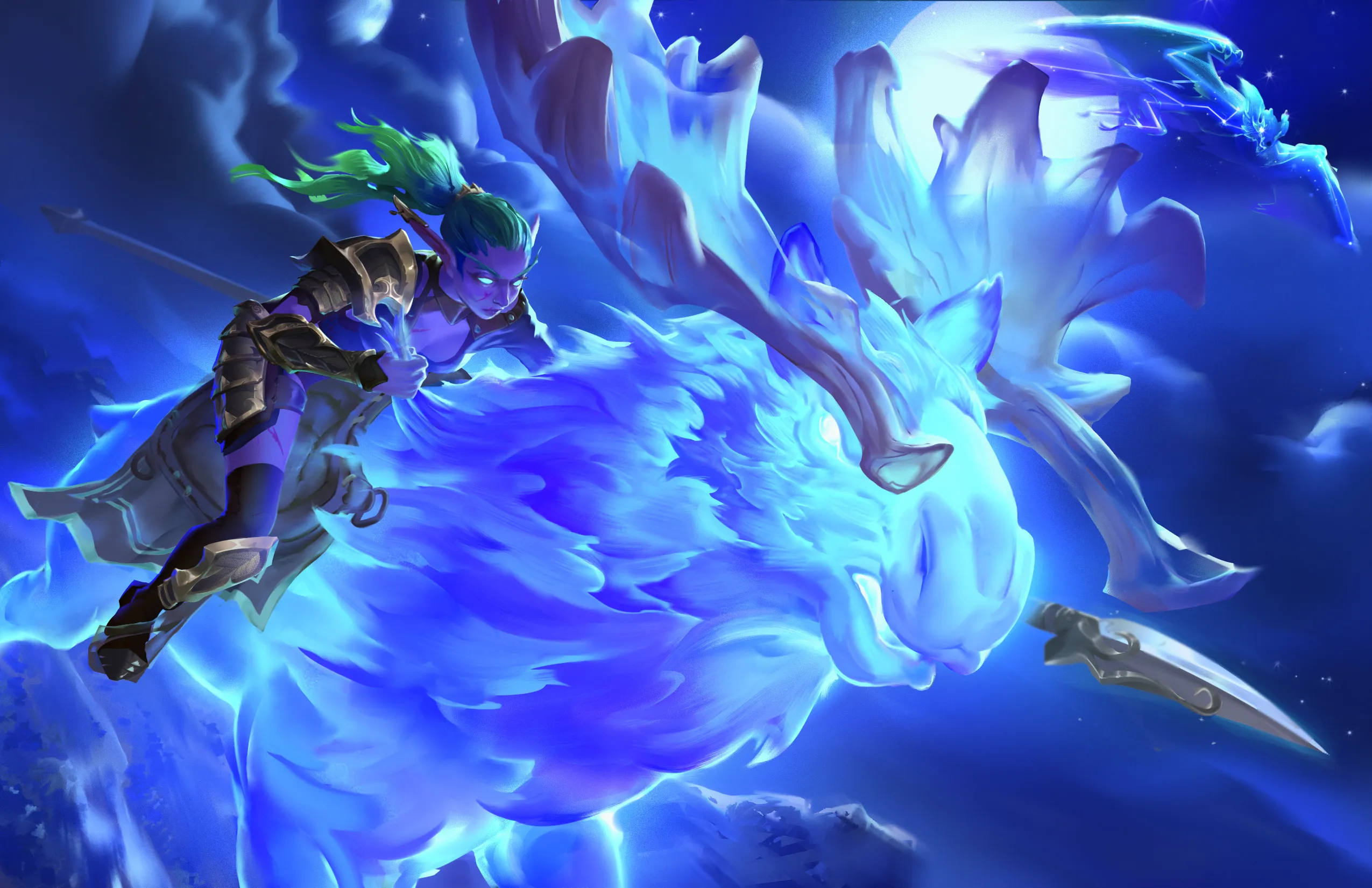

Dungeons & Dragons and World of Warcraft are two of the biggest fantasy games around, even though they exist in completely different mediums. As such, a crossover between the two is a natural fit (I bet there are plenty of D&D groups who also run raids in World of Warcraft together), but the form of that collaboration is less certain. In a private presentation breaking down the upcoming Dungeons & Dragons: World of Warcraft project, the designers made their approach clear: this book is a toybox.
“This book is absolutely a toolbox or toybox that you can use to fill your D&D game with these sorts of adventures, and I think the dungeons represent that really well,” senior game designer Joey Haeck said. “There are a lot of tools at your disposal that I think make it really easy for a DM to explore the world of Azeroth with their players.”
This isn’t a linear, pre-written campaign, but a set of curated crossover locations, character options, magic items, and monsters for players to build their own version of events. Of course, as Haeck mentions, the book also includes some of the most iconic dungeons from World of Warcraft’s history, and if your DM isn’t interested in coming up with a narrative framework to tie everything together, you’re welcome to just storm some castles together. The book also includes advice on building campaigns around World of Warcraft villains, many of which have stat blocks included.
Each dungeon is designed for parties of a certain level, defined in D&D as tiers of play. You can venture into the Deadmines and Shadowfang Keep at levels 1-4; Blackfathom Deeps at levels 5-10; Dire Maul at levels 11-16; and Azjol-Nerub at levels 17-20. There’s also the Scarlet Monastery, which is designed for levels 5-10 or 11-16 depending on which wing you’re exploring, and Onyxia’s Lair, designed for characters level 17-20 and centered around a boss fight with the dragon who dwells within. Yes, this is a dungeon with a dragon; as I said, the crossover is a natural fit.
Dungeon layouts are pretty loyal to their MMO counterparts, though Haeck mentions they’ve added new secrets and shortcuts to some, which will be a surprise even to players intimately familiar with the maps. And while most problems in World of Warcraft are solved with combat, the D&D adaptation allows for alternate solutions, like stealth and negotiation, where it makes sense. Still, if you want to go in guns blazing, you’re more than welcome to. Some dungeons include random combat encounter tables for that very purpose.
The foes on those tables are a mixture of newly designed Warcraft monsters and existing D&D monsters, some of which are re-skinned to fit the Warcraft universe. For example, there’s already a stat block for a water elemental in the 2025 Monster Manual, but if you want players to face off against a Murloc, the book includes rules to convert a table of humanoid stat blocks by adding the Amphibious trait and a swim speed.
Meanwhile, characters like Jaina Proudmoore, Sylvanas Windrunner, and the Lich King Arthas each get their own unique stats, rated at a challenge rating of 22, 23, and 25, respectively. And while there are plenty of dragons in D&D, their abilities don’t line up one-to-one with those in the Warcraft universe, so the crossover will include Green, Blue, Red, Black, and Bronze Dragonflight Dragons to square up against.
While the presentation was more DM-focused, it ended with some player-centric mechanics. Tool proficiencies (which can fall to the wayside in many D&D games) are repurposed to correspond to World of Warcraft’s professions. There’s guidance on how gathering professions can be used to collect resources and how production professions can be used to craft new items.
Finally, we saw some of the game’s factions, which parties can gain affinity with using D&D’s existing Renown system, found in the Dungeon Master’s Guide. There’s the Alliance and the Horde, of course, but the book includes “more than 20” factions total, including the Argent Dawn, the Cenarion Circle, the Earthen Ring, the Explorer’s League and Reliquary, the Kirin Tor, the Steamwheedle Cartel, and the Valdrakken Accord. Raising your Renown brings mechanical advantages – allies of the Earthen Ring can use the faction’s portals, and the closest allies of the Valdrakken Accord are granted a wish.

It’s a toybox with plenty of options, and I’m excited to see it all laid out, but it’s a pretty daunting project. World of Warcraft has decades of history crafted with a fundamentally different design philosophy than Dungeons & Dragons. Because of that, you could never fit it all into one book, and it could never feel the same as the experience on a PC. The design team knows this, however, and has structured the book accordingly.
“I’ve been trying to shift my thinking to talking about [paraphrasing],” project lead designer James Wyatt said in the presentation. “Because we’re not doing like a word-for-word translation of any WoW game mechanics. The game you’re sitting down at the table to play is still D&D in the setting of World of Warcraft, and with a lot of the trappings of World of Warcraft […] So the goal is to try to evoke the feeling of playing WoW and let you interact with the characters and creatures and abilities that you have as a WoW character, while also opening up the world for you to explore in a whole new way, because you can talk to anybody that you meet, you can interact with anything you see. Which is the beauty of a tabletop game.”
For more on the new books coming to Dungeons & Dragons, check out our recap of the publisher’s massive Gen Con presentation.



Leave a Reply