
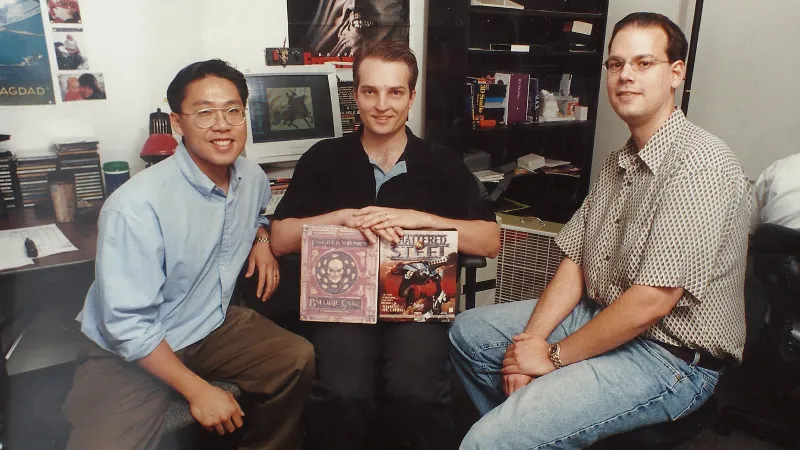
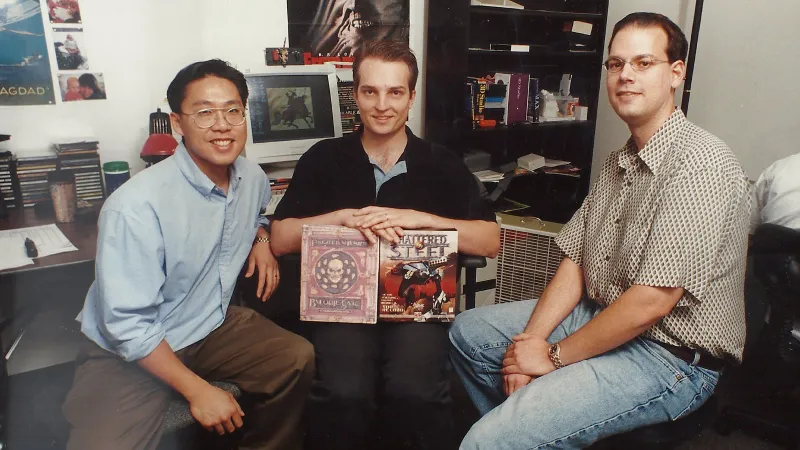
BioWare founders Augustine Yip, Greg Zeschuk, and Ray Muzyka show off their first two game releases, Baldur’s Gate and Shattered Steel

Introduction
Bloomberg is reporting today that BioWare is being shut down amid a flurry of layoffs at EA. To honor of the studio’s impressive contributions to the video game industry, we’re making public our expansive oral history on the studio that previously appeared exclusively in Issue 284, The Mass Effect: Andromeda issue.
This feature from former managing editor, Matt Bertz, covers the full history of BioWare up until the feature’s publication in December, 2016.
Twenty years ago, Dungeons & Dragons was considered by many to be a Satanic game played by mentally imbalanced adolescents, and role-playing games were a fringe genre in video games. That was the reality when two doctors decided to start up a game development studio on the side of their medical practice back in the mid ’90s. Fast forward two decades, and BioWare stands as one of the pillars of a genre that has since become a destination for millions of players and infected nearly every other type of video game, from sports games to shooters. With franchises like Baldur’s Gate, Star Wars: Knights of the Old Republic, Mass Effect, and Dragon Age the studio put storytelling at the forefront of the role-playing experience in a way that changed the genre forever. To commemorate the studio’s long-standing commitment to excellence, Game Informer interviewed several BioWare developers, past and present, along with several other noteworthy industry figures who worked alongside them, to recollect how an unassuming studio in the far-flung Canadian prairies managed to become RPG royalty.
The Origin Story
Growing up in Canada in the ’70s, Ray Muzyka and Greg Zeschuk are exposed to video games at an early age. Titles like Pong, Castle Wolfenstein, and Pirate’s Cove capture their imaginations and compel each to take up programming as a hobby. Their paths first cross in college.
Greg Zeschuk: Both Ray and I went to University of Alberta in the late ’80s. We were in inorganic chemistry together, that was the first class we met each other. Then we went to med school together, and that’s where we got to know one another. Ironically, we bonded over the foosball table.
Ray Muzyka: We also played a lot of video games. It was a common passion. We started doing some medical-education projects, too. We’re both self-taught programmers. So we signed up with our third co-founder of BioWare, Augustine Yip, who’s a doctor as well. He left BioWare pretty quickly after we incorporated to go full-time practice in Calgary, but we started the company together.
Muzyka: We named the company BioWare – software for humans. It was a play on words that there are three doctors kind of working together.
Zeschuk: We used to have one guy that since the beginning told us it was terrible.
Muzyka: There were a lot of people that told us that. Some people, their names will be not mentioned, told us we would never build a brand. I remember that very clearly, there was one meeting that we had… [laughs].
Zeschuk: It’s a circular reference for our future owner, but not anyone relevant.
Muzyka: We did medical-education software projects together, like an acid-based physiology simulator. We understood it was a pretty tough market to get in.
Zeschuk: People don’t want to pay for education or health, especially in Canada, so when you combine the two…it’s very difficult. Then we realized, okay, let’s try games.
Hiring in Edmonton, no one had ever really worked on a game before. So we had all of these video game noobs that were just trying to figure it out.
BioWare founders Augustine Yip, Greg Zeschuk, and Ray Muzyka show off their first two game releases, Baldur’s Gate and Shattered Steel
Muzyka: James Ohlen is another great example. He was running a comic book store in Grand Prairie, a small town in northern Alberta. We hired him because we heard from other guys in that area that there was this guy up there running a D&D campaign with a waiting list. He was running this comic book store so he could only run two campaigns, but he had a waiting list and as soon as anyone would drop out people couldn’t wait to sign up.
Zeschuk: And he traded his Magic cards for a car so he could drive to work.
Muzyka: We originally set up in Greg’s basement. That was our first office. Scott Greig went to the basement for an interview and he was ready to run out of the room. He was like, “Are these guys for real? Two doctors want to start up a video game company for some reason?”
Zeschuk: I think people thought it was a phase. Even for us, on some level we thought we’d go back to being doctors.
Muzyka: I didn’t think that at the time. Obviously that would have been the case, but it wasn’t part of the thinking process because I was too dumb to realize the business might not succeed. We didn’t take a salary for five years at BioWare either, so the fact that we could work once a month as a doctor and buy soup and beans and pay off our maxed-out credit cards and lines of credit and our mortgages and stuff was helpful. For me, anyways. I couldn’t have survived without that. It was a pretty tough existence, but it was fun.
Zeschuk: We were young, so the resistance to that stuff was higher.
Rather than start small with one project, the scrappy team works up two game concepts simultaneously, a mech combat game called Shattered Steel and a role-playing/strategy game code-named Battleground Infinity. The doctors begin shopping for a publisher.
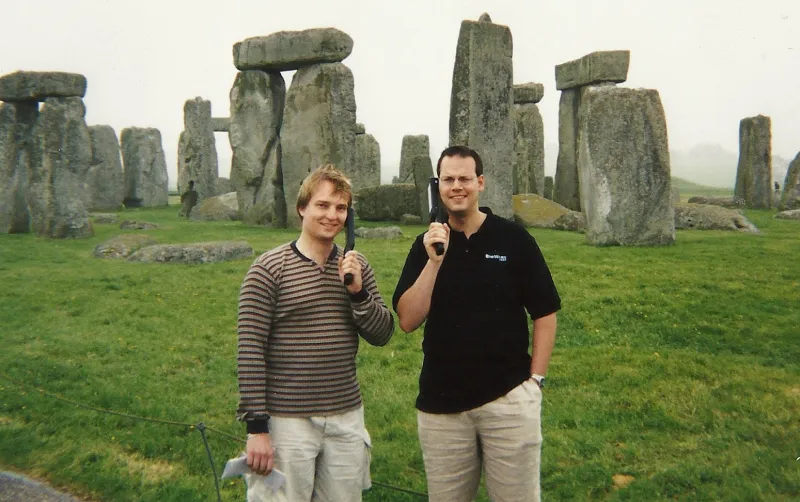
Greg and Ray tour Stonehenge during the early days of BioWare
Muzyka: We made a list of the top 10 publishers worldwide at the time. I think only one of them is still around. We divided it into two and started cold-calling them, over and over, until they started taking our calls. I think we got almost all of them to start making an offer.
Zeschuk: They had these giant piles [of games] they never looked at, but since we kept bugging them they’d be like, “Fine, fine, we’ll look at it.” Shattered Steel in particular was really good technology for the time – 3D objects in a 2.5D space.
Muzyka: Nine out of ten publishers made an offer on a demo from two doctors and an unknown team from Canada based on a twenty-page business plan and a relatively crude prototype.
Brian Fargo: I met them when they presented the Shattered Steel project to us. They wanted to take on MechWarrior from Activision, and they had a great little demo. Super passionate, super detailed, and I was impressed with their knowledge of the category and their approach.
Feargus Urquhart: I thought it was super cool that Ray and Greg were incredibly involved in not just the managing, but in the development itself. Greg wrote one of the tools that was used to get the models in the engine.
Muzyka: Story and character were a big part of what we did from the beginning. That wasn’t popular; a lot of people were saying it was a bad idea. Even Shattered Steel, it was an action game but we added story to it in a way that wasn’t common at the time. We had a story arc that went through and tried to explain everything. It was bolted on near the end, but for us that was important. It made the world complete.
Zeschuk: I think closing [Shattered Steel] was sort of surreal because we had never done it before, we didn’t know what to do. I think the biggest thing was willingly we always strove to learn something from what we did. We had no QA, no testing, so everyone was just playing it. The whole idea of crunch time and working really hard, it was actually really exhilarating.
Muzyka: Caffeine-fueled mania. It reminded me a lot of being on call as a doctor, too.
Zeschuk: When we actually finished it, it was remarkable. We’d often lurk in stores, wait, and watch someone actually buy the game we made.
Critical Strike
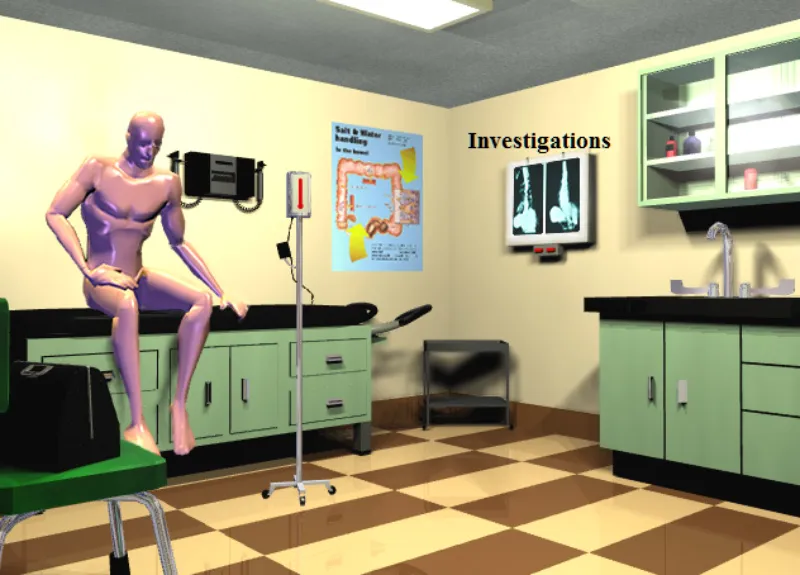
BioWare’s first product (shown here) was a medical software called Gastroenerology Patient Simulator
During the development of Shattered Steel, BioWare was also shopping its role-playing game, code-named Battleground Infinity. Interest originally proved tepid.
Muzyka: Some of where we came from was almost rebellious. We loved role-playing games growing up, and our desire was to try something no one else was doing. I think that benefited us because we weren’t trying to tackle a red ocean. There was a big opportunity there, but people were saying role-playing games were dead, that we wouldn’t ever succeed. We heard that so many times.
Urquhart: They came up with the idea of Battleground Infinity. It was all about the gods. There were a ton of different gods, like an RPG and an RTS smashed together. That’s why Baldur’s Gate has this view and control mechanism, I think, because Battleground was more of an RTS.
Initially, what they sent me wasn’t enough for me to think we wanted to do another game with them at the time. Thankfully, they continued to work on that demo and had been presenting it to Westwood and Sir Tech.
Zeschuk: We mentioned to Feargus that, “Hey, we were just down the street [pitching the game] at Virgin.” He was like, “Can I take a quick look at it?” So we go over, and he goes, “Hold on.”
Urquhart: During all this, Interplay had signed the Dungeons & Dragons license. So I said to them, “What about this being a D&D game?” They said, “That would be super cool.” This is big business talk back then. I said, “Let me see what I can do.” It was a little challenging, and my boss at the time actually thought it was a stupid idea. So I brought in the VP of marketing and I sold her on it. She brought Brian Fargo and he looked at it for like three minutes and said, “Sign it up.”
Fargo: With D&D, I felt that if I could get the developer that really understood and appreciated the roots and really focused on the detail of the experience, that we could do something with it. And that’s what [BioWare] offered. When they showed me their product, I remember visually it showed a lot of promise.
James Ohlen: That tech became the basis for Baldur’s Gate.
Muzyka: I always thought of Baldur’s Gate as a strategy/RPG. We merged in some strategy elements. We looked at control mechanics of games like Command & Conquer and Warcraft II. We looked at the character interactions of Jagged Alliance from SirTech – they would react to things you did. So that element made it into the game as well. I think we came up with the control-mechanic formations on our own, but it was based on some stuff we saw in strategy games. Combine that with the best-of-breed RPG fundamentals…and that was what pulled it together. And D&D obviously. We wanted to make it feel like you were playing D&D with your friends.
Kevin Martens: I think that’s the secret thing and I still recommend to this day, if you don’t play pen and paper as a dungeon master you’re not going to be a good game designer. That’s where you learn. If you can keep people coming back to your kitchen table every Sunday afternoon time after time and they can’t wait to learn what happens next, you’re learning game design no matter how informally you’re learning it.
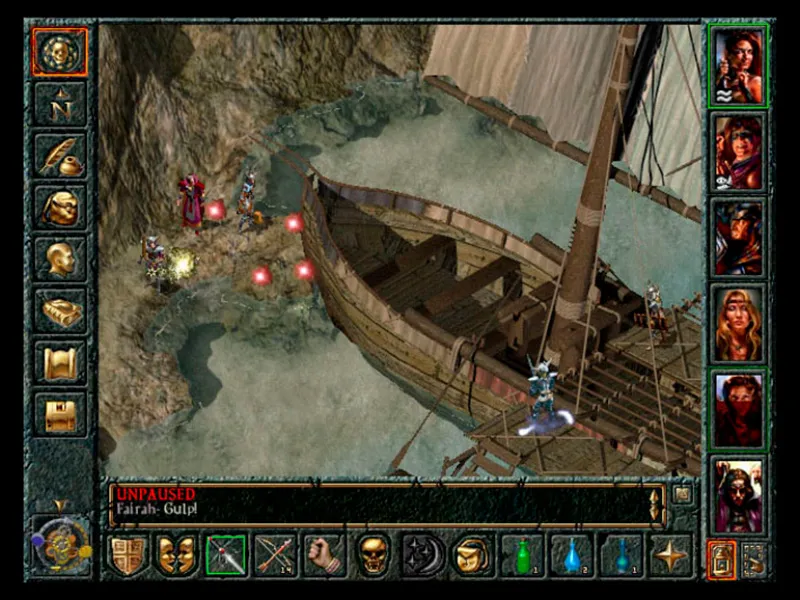
Baldur’s Gate
As the team raced toward its scheduled release date, BioWare and Black Isle Studios ran into roadblocks. Baldur’s Gate wasn’t ready for its planned release date, and the marketing department didn’t want to waste money promoting it because role-playing games were still considered niche.
Fargo: If you shipped on December 21, you’ve really missed Christmas, right? Because you’re not in most other retail channels. So we sort of sucked it up and said, “Look, this thing has way too much promise.” Our reputation was always paramount, so we didn’t want to shove something out the door, so we absorbed that hit and gave them the extra time to get it right.
Urquhart: Dungeons & Dragons was a brand no one believed in anymore. We were working with this idea that the [Baldur’s Gate] sales forecast was 70,000 units in the U.S. and the sales forecast for Europe was 0. The challenging thing about that is that sales forecasts are where you get your marketing budget. Interplay at the time did these big sales meetings where we’d bring sales reps and the actual buyers and have all these presentations, something of a boondoggle, but I went to Brian and said, “I need you to tell people Baldur’s Gate is going to be awesome. They need to hear it from you.” So he did. He really sold it.
Fargo: If you wouldn’t launch a company around the title, you probably shouldn’t be doing it.
Urquhart: At the time, CompUSA was being a big pain in the ass. We told them, “This product is going to be huge.” They were like, “We don’t care.”
Muzyka: Diablo came out, and that was one of the first good RPGs in a while. Then Baldur’s Gate came out soon after. Both of those had been in development while everyone was saying, “Let’s not do these.” They kind of died because they stopped being fun and when you release games that are, all of the sudden, hey there’s an audience for these again.
Urquhart: At the Christmas party in ’98 I was talking to Brian Fargo, who said, “I’ve got a funny story for you. I had the CEO of CompUSA call me to ask for units.” Because they took none, and everyone was selling a ton, he said, “Will you please give us units? You don’t have to pay, provide end caps, anything like that. We just need units.” The funny but sad part of that was that the CompUSA buyer who did that to us, they actually fired.
Muzyka: I don’t think any of us really had any idea it would sell the millions of copies that it did in the end.
Zeschuk: We didn’t know what it sold. It took a while to get royalty checks because they are delayed based on the publisher getting paid. It was quite a while before we realized how big Baldur’s Gate was. We started winning a bunch of awards.
Muzyka: At the same time, both of us still practiced medicine. I did more ER and family med and Greg did some ER, family, and geriatric work. I practiced for two years full-time before we incorporated BioWare.
Zeschuk: I just remember one day, l was on call at the geriatric hospital, and going, “Wait a minute. I worked at BioWare all day. Here I am, laying in the hospital. Why on Earth am I doing this?” That was the moment for me when I realized it. It’s interesting because that came after Baldur’s Gate was successful. By the time we knew it was huge, we actually were still working in that cross-over period. I decided to retire at that point.
Muzyka: I think Greg retired from medicine a year or two before me.
Potion Of Fortitude
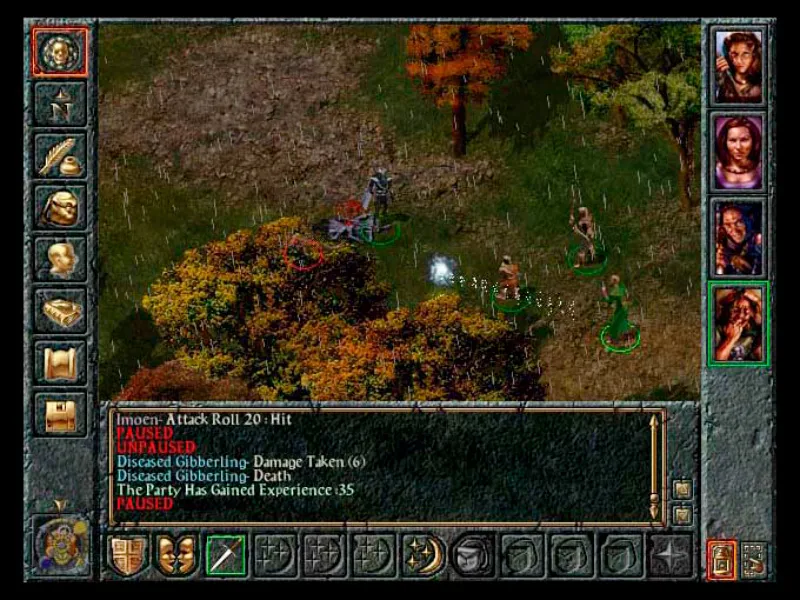
Baldur’s Gate
Following the commercial and critical success of Baldur’s Gate, BioWare transitioned one team immediately into the Tales of the Sword Coast expansion, while three other teams started work on Baldur’s Gate II: Shadows of Amn, Neverwinter Nights, and the studio’s first console game, MDK2.
Aaryn Flynn: The ambition for Baldur’s Gate II was incredibly high, so we had lots of pressure on us to deliver that.
Muzyka: We targeted several areas for improvement: Improve the user interface, improve the graphic resolution, tighten the story, obviously extend it so you could carry your character you imported to a higher level, and still start a fresh character if you wanted.
Zeschuk: I think the biggest thing with that game was we didn’t make almost any engine changes. A lot of times when doing quality assurance, you’re changing fundamental structure and have to start from square one. But with BG II we literally picked up right after BG I, kept a similar technology base, and just kept chugging with it.
Martens: We just wanted to do more. What I realize now – I’m 18 years in – is just how lucky we were to have a super stable engine. We could hit the ground running. We had very few new features for Baldur’s Gate II that stopped development at all.
Flynn: After BG, James [Ohlen] was very proud of the reviews of the story coming in. But this fellow Diarmid Clarke gave him a dose of humility when he told him that FFVII characters were so much better-developed.
Ohlen: I’m very competitive, and SquareSoft was killing it with the Final Fantasy series. They were doing a lot of things better than us in how they built up characters, made people love them, roman-ces, all the rest. So that was a big inspiration for Baldur’s Gate II. I really wanted to take the crown away from SquareSoft as the studio that did the best story, the best characters, all that.
Martens: My story of James is that he has always had a vision grander than anyone else around me. Here was this kid in Edmonton, Alberta, trying to take down the long-time kingpin of RPGs. That’s not possible, right?
Flynn: So much of what we did back then, the eagerness was 80 percent of it. It was less about what you knew, because no one knew anything at the time. What the hell did folks in Edmonton know about how to make computer games other than they made one or two at that point?
Ohlen: In Baldur’s Gate, the stories were quite simple. The characters got introduced in the main storyline and their personalities were developed through the barks they had, and they were quite dumb. For Baldur’s Gate II, we reduced the number of characters because we realized we wouldn’t have the time to do a storyline for the same amount of characters. But we gave every single companion in BG II their own area and story that introduced them, so they were key characters in the major storylines.
Martens: The biggest challenge of it was we wanted to represent a lot of different viewpoints, because you could be any character. The challenge of BioWare storytelling in that era was you could be anybody from anywhere, any class, any gender that’s available in D&D, and by the time we were done you could even be any subclass. But somehow the story had to work for all of these. It was the same thing with romance – how do you write one romance like how Final Fantasy might do for a game with a character that could be any character of any gender?
Flynn: The QA for that game was nuts. What we lacked in discipline we made up for in energy and passion for what we were doing.
Martens: Some of the memories that stand out for me were seeing how fast we could get through the game. We figured we had about 150 hours of content, but we kept adding it right until the end because there was no reason not to since you didn’t have to wait for VO or all that stuff. We ended up with about 240 hours, and then we would race the critical path to see how fast we could finish it. I think the fastest we ever got through it was 1 hour and 58 minutes.
Fargo: I still think it’s probably one of the biggest RPGs of all time in terms of number of quests you can do.
Martens: Everybody felt the aftermath, everybody had a down period at the end or a recovery period – whatever you want to call it. James used to sleep under his desk. He actually wouldn’t go home. Someone would bring him clothes from home, he wouldn’t even go home to change, he would get one of his roommates to bring it over. Because three of the four people he had lived with worked at BioWare. That’s probably too far. I don’t think James felt that way at the time, and I don’t think it affected his life, but he didn’t have a child at that time. I felt something was wrong with crunch back then, but I didn’t know any other way to do it. And I have to admit we brought a lot of it on ourselves by making plans that were grander than the staff we had or the knowledge we had to do it.
Ohlen: It was the most fun I ever had as a game developer.
Baldur’s Gate II shattered expectations and earned massive critical acclaim; it still ranks sixth on Metacritic’s list of the highest-rated PC games of all time.
Solo Questing
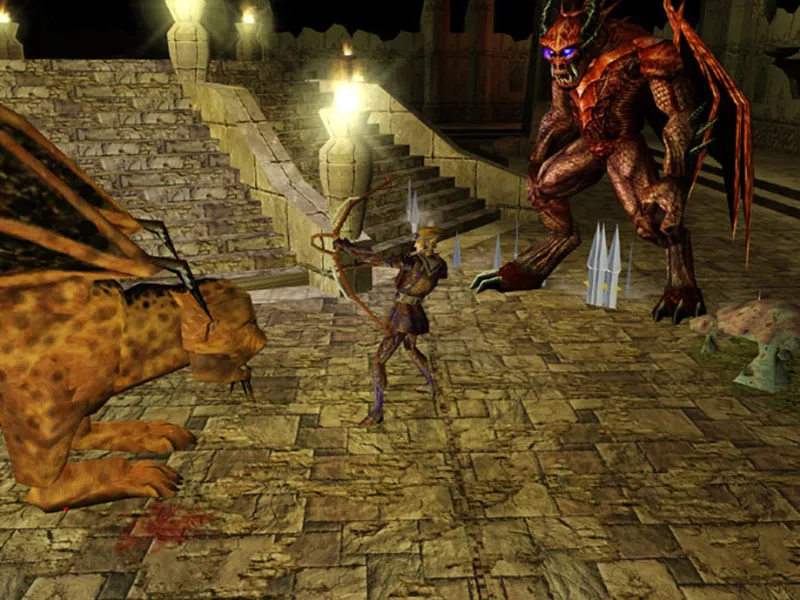
Neverwinter Nights
Following the success of Baldur’s Gate II, BioWare was in the midst of its most ambitious project to date. On top of an original campaign built on the 3rd edition Dungeons & Dragons rules, Neverwinter Nights offered a full set of editing tools so players could create their own modular experiences, plus an online infrastructure for questing with friends. During development, problems arose at Interplay.
Flynn: Neverwinter was a very challenging development. It was our first 3D role-playing game.
Zeschuk: The vision for Neverwinter was very clear right from the beginning: toolset, DM client and game – these things were just a huge undertaking. It was a big, complicated game.
Muzyka: It was part of the core vision right from the start to enable user-generated content. We had this long-term vision that we wanted to make and capture the D&D experience. We felt that enabling someone to be a dungeon master, to have control over it in real time in a multiplayer or single-player setting, and allow users to make content to expand the universe out would be part of it. Then we would have a curated online store where we would present the best of the user-generated content for other players to see. Trent Oster, the project director, had a grand vision for NWN that encompassed all of these game pillars; it was definitely an ambitious game.
Zeschuk: I would say one of the biggest financial risks we took was paying for Neverwinter Nights. That was a big dice roll.
Flynn: We always had this ability to convince ourselves, “Ah, ambition smambition, we’ll get it done.”
Muzyka: We talked with Will Wright, who talked about the pyramid of user-content creation in The Sims. That was one of the inspirations for sure. You had this community that had a lot of players, and a certain number of people that got involved in the online aspects, and a certain number of players that would make things, and the certain number that would make really complex, interesting things. So we were trying to create that, enable the players to have that power in the Neverwinter setting and a D&D setting. We thought, “This has never been done before.”
Ohlen: It was kind of disappointing because we just knocked it out of the park with Baldur’s Gate and Baldur’s Gate II, and then all of a sudden, Neverwinter Nights was in danger because Interplay was blowing up.
Muzyka: We hadn’t been paid any of the royalties [for Baldur’s Gate II]. We were owed a lot of money.
Fargo: BioWare was a little out of money, and probably one of the biggest creditors at Interplay. I remember saying, “Hey we’ve got to do something clever to get these guys paid.”
Zeschuk: There’s actually quite a dramatic business story behind the whole transition. When the wheels fell off at Interplay, there was a pretty ambitious deal brokered with so many people involved – us, Interplay, and was it Infogrames or Atari at the time?
Muzyka: Infogrames first and then Atari, they had a name transition halfway through. Then Titus [who acquired Interplay] was involved, as well as Wizards of the Coast and TSR.
Zeschuk: The business side was like threading a needle. I mean we were in negotiations every couple days for six months.
Ohlen: It could have gone really wrong. Neverwinter Nights was like, “If we make this and it isn’t successful, that’s the end of the company.”
Darrah: We were probably within months of having no money…but it never really seemed to be reflected in in the culture itself. Everyone was really focused on making the games themselves.
Muzyka: It got resolved amicably in the end, but we launched a lawsuit to get paid the royalties we were owed and to protect Neverwinter.
Martens: The day that we got the deal with Atari, they gathered the whole company together and told them we had a new publisher. Everyone had a very big cheer.
Watamanuik: Neverwinter Nights was a very stressful project. I did a lot of crunch on Neverwinter; it was like six months where I didn’t get to see my wife very much.
Ohlen: I was working on Knights of the Old Republic at the time, but the executive producer on Neverwinter Nights at the time, Trent Oster, was like, “You got to come over here and take over the project and make sure it’s actually successful.” I had to put my work on KOTOR on hold, go to Neverwinter Nights, take all the writers from across the studio and work on getting Neverwinter Nights out the door.
Martens: Everybody ended up on Neverwinter to ship that again. I think that’s the last game where we did that, where the whole company had to ship the game.
Watamanuik: I was really happy with how close we were able to map the game to the actual Dungeons & Dragons rule set.
Flynn: It was really cool once we got stuff out there and we saw people making it. Every week something would go around the office and you would go, “Wow, look at this.”
Darrah: It definitely had a long legacy, and it arguably has probably shaped a lot of what we see today in terms of RPGs with toolsets and trying to have these very long, user-supported tails.
Zeschuk: Every once in a while you go across these kind of what-if scenarios and you go, “What if we actually kept on going in that direction?” If you look forward past that, we’ve shifted harder toward story, but we’ve shifted away from that user-generated content… It’s something I wish we had pushed harder, but you only have so many resources and you have your focus and perspective at the time.
Ohlen: I used it as the most powerful hiring tool I ever had. I kind of miss it. The guys who I would bring in were able to do ridiculous things with the tools like, “How the hell were they able to do that?”
Watamanuik: It was responsible for an entire generation of design talent that came into the studio because they had worked with and understood the Neverwinter Nights Aurora engine. Great PvP mods that came out of that, and great technical demos. Our first cinematic designer at BioWare, Brad Prince, completely hacked the Neverwinter Nights engine to be able to accomplish some of the first cinematic scenes that we did in our games, and it was because of that deep understanding of those tools and what you could accomplish, the power of the scripting language.
The BioWare Timeline
Recent University of Alberta medical school graduates Ray Muzyka, Greg Zeschuk, and Augustine Yip funnel their passion for video games into a new company, called BioWare. Not one of the founding members had any previous professional experience developing video games.
BioWare releases its first game, a mech combat simulation called Shattered Steel. The game gets average review scores.
BioWare’s first RPG, Baldur’s Gate, puts the studio on the map. Along with Blizzard’s Diablo, the game revitalizes the role-playing genre on PCs. Metacritic: 91
The studio releases its first console game, MDK2, on Sega Dreamcast. Metacritic: 83
Baldur’s Gate II: Shadows of Amn releases to widespread critical acclaim. Metacritic: 95
BioWare successfully retains the D&D license following the closure of Interplay and self-funds the creation of Neverwinter Nights. Metacritic: 91
LucasArts and BioWare team up to deliver Star Wars: Knights of the Old Republic to the nascent Xbox platform. Metacritic: 94
Elevation Partners invests in BioWare and Pandemic Studios, allowing BioWare to pursue its goals of opening new studios and creating new IP.
BioWare releases Jade Empire, its first original IP since Shattered Steel. Metacritic: 89
Electronic Arts, now led by Elevation Partners founding partner John Riccitiello, purchases BioWare Pandemic for $860 million.
The first game in the Mass Effect series releases to strong praise. Metacritic: 91
Sega partners with BioWare for a Sonic-themed spin-off RPG called Sonic Chronicles: The Dark Brotherhood. Metacritic: 74
BioWare’s lengthy incubation period for designing a spiritual successor to Baldur’s Gate comes to a close with the release of Dragon Age: Origins. Metacritic: 91
Mass Effect 2 releases to resounding critical praise, earning BioWare its highest Metacritic score to date. Metacritic: 96
BioWare rushes Dragon Age II through development, and the game is met with mixed reviews. Metacritic: 82
BioWare’s lone MMO, Star Wars: The Old Republic, releases after a lengthy development period. Metacritic: 85
Mass Effect 3 concludes the trilogy with a controversial bang. Metacritic: 93
The two remaining BioWare founders, Ray Muzyka and Greg Zeschuk, announce their retirement.
Dragon Age: Inquisition rights the ship for the franchise. Metacritic: 89
BioWare officially announces Mass Effect: Andromeda, the next chapter in the space saga.
Joining The Jedi Order
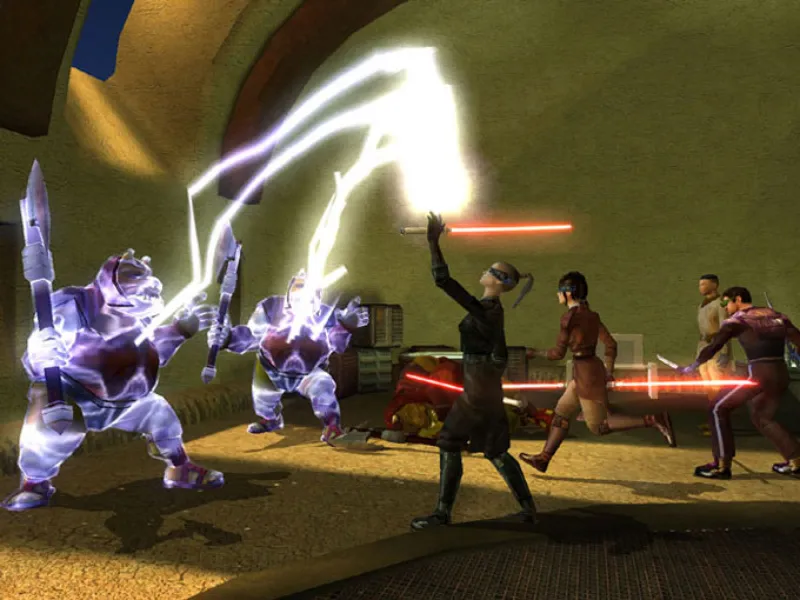
Star Wars: Knights of the Old Republic
While the studio wrapped up Neverwinter Nights, BioWare received the offer of a lifetime to work on the most popular science-fiction franchise in the world.
Zeschuk: Ray and I were trying to figure out what we were going to do next.
Muzyka: We had a list of IPs that we had been in contact with the owners of…they were big names.
Zeschuk: We had an X-Men RPG idea.
Muzyka: Yeah, Marvel was one of them, and there were a few other big ones. I think we were in contact with some of The Lord of the Rings folks.
Zeschuk: I remember the meeting that we had when we talked about Star Wars. When we had gotten the call we were kind of pinching ourselves. We literally had a meeting the next day…
Muzyka: Yeah with our senior team, and we were getting their feedback on where we should go and…
Zeschuk: We wrote the names down on the board, right? All these names we had already talked about, and then we put “Star Wars RPG” at the top and they were just…
Muzyka: Everybody was like, “Are you effing kidding us?” and we were like, “Nope. Actually we just got the call.”
Flynn: We were like, “My god, this is big time. A Star Wars game?” We had all grown up loving Star Wars, so it was nuts.
Muzyka: LucasArts asked if we wanted to do something set between the movies, but Simon Jeffery told us that would involve a lot more creative restrictions. Or we could go back to this series of comic books by Dark Horse called Tales of the Jedi. It was like the Wild West of the Star Wars period, thousands of years before the movies where there’s Sith and Jedi running around having battles and the history of where the Sith came from and the Jedi Order, and the nuanced nature of it too. It’s not black and white good and evil; it’s actually just they both think they’re right.
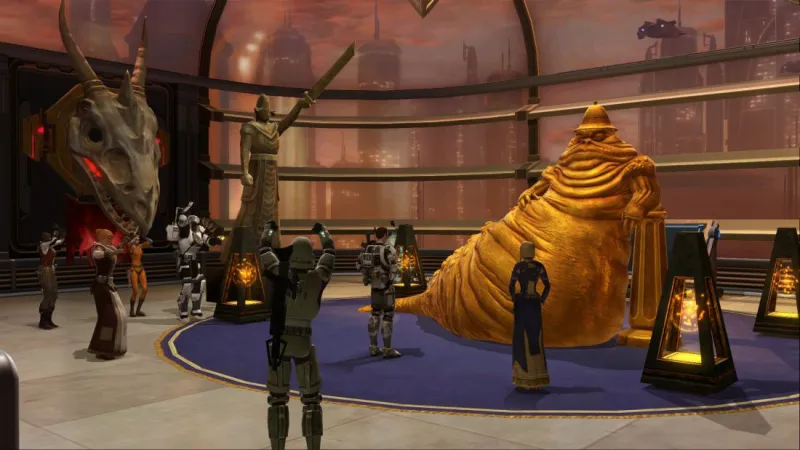
Star Wars: The Old Republic
Hudson: When you work on Star Wars, or anyone else’s big and important property, one challenge is to what degree are they going to push back and tell you what you can and can’t do. Working on Knights of the Old Republic was amazing because for the most part we didn’t feel constricted.
Flynn: We had this vision with two key things. One was to create this choreographed combat system that made it look and feel like you were having lightsaber battles. The other was a cinematic storytelling camera.
Ohlen: We wanted to do full voiceovers for all the characters, and we wanted to do cinematic scenes. Make it feel more like a movie because we felt that Star Wars was a more cinematic experience than Dungeons & Dragons.
Flynn: It was really intense. The stakes were very high. LucasArts was a good partner, but they were certainly a bigger, less intimate partner than we had with Black Isle/Interplay.
Watamanuik: When Drew Karpyshyn and James Ohlen said, “Here’s the twist,” I understand the reaction from the team was actually pretty lackluster. Kind of, “That’s your big twist, you’re Revan?” I use that as an example today, as it’s exceptionally hard to impart the magic of a moment in the game on paper.
Ohlen: When Drew and I watched The Sixth Sense and Fight Club, we analyzed them and broke them down, and we felt that we knew how to do a twist properly. But I was surprised by the success of [the Revan twist]; I couldn’t see as it was coming out.
Muzyka: [The game] told you you were Revan at the exact moment your subconscious transferred to the conscious. So it felt like it was a magical moment. That was one of the high points of that game for me.
Hudson: As time goes by and people continue to refer back to it as being the twist that they really remembered, I don’t think we ever expected it would have worked that well.
Flynn: I think it’s in the top ten story-telling moments in the industry.
New IP Style
Following the success of Knights of the Old Republic, BioWare made an aggressive turn toward creating its own intellectual property in hopes of landing a sustainable franchise. To go forward with the plan, the team dug into its trove of concepts dating back to its early years.
Muzyka: The kung fu setting had always been one that appealed to a lot of our team members. It was different than science fiction or fantasy and something kind of refreshing and different and unique. It seemed like there were a lot of great opportunities for exciting stories and characters. We looked at Legend of the Five Rings and…
Zeschuk: …Many kung fu movies as well.
Muzyka: Even back in the days of Baldur’s Gate we were talking about this as a potential setting.
Fargo: They wanted to do a kung fu role-playing game, and I just wouldn’t do it. Like every six months, they’d say, “Come on!” They’d want to talk me into it. And I couldn’t get excited about it.
Zeschuk: Early on, we built a really simple demo in Baldur’s Gate, and then edited this silly trailer. The idea at that time was to take the BG engine, take this demo, and then take kung fu movies and re-dub them, because they were already dubbed to make the story. So we did this demo where we redubbed these kung fu movies. That kind of percolated for a long time.
Flynn: I think it was called Five Fingers of Death. I think they called it that in homage to the film, but it was just an internal title to give people a sense of what is was.
Fargo: I just thought of all the things we could be doing with BioWare, it wasn’t the best use of their time to do an Asian, kung fu-style product. There was just so many things I could think of that I could do better and bigger with BioWare than that.
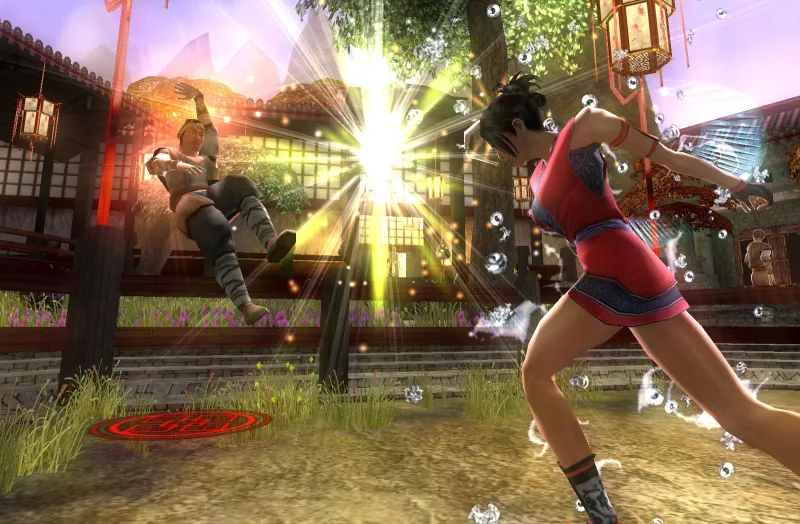
Jade Empire
Flynn: There was this concept of classes that would morph into styles, but those styles would be flexible and changeable… And then when Crouching Tiger, Hidden Dragon came out in early 2000, it sealed the deal that we were doing the right thing.
Martens: Our goal was to capture that fantasy – can you feel like one of those heroes in that movie? Can it still feel like a BioWare game? We wanted to make an action game as well, so again we were biting off more than we could chew.
Zeschuk: The crux of the challenge of the game was the real-time combat system. What was interesting about it is we didn’t have a language on how to talk about it. We’d talk a lot about feel – “Hey, this doesn’t feel right.” When you think of other guys who make fighting games, they probably have this whole language or expertise, whereas for us, we hadn’t had that expertise. We were these RPG experts.
Muzyka: It was actually a factor of what we wanted to do. We consciously wanted other types of genres and to see if we could take what’s fun about those and merge it with what’s fun about role-playing games.
Flynn: One of the reasons it took five years is you realize just how little there is to push off of a blank canvas. How do you start, what do you do when you put things on the canvas? It takes different skills to create IP than it does to build great games based on others’ IP.
Zeschuk: Jade was our transition point from old-school RPGs to new-school RPGs. That’s where we tried out all this new stuff, learned a bunch, and then started applying it moving forward. People don’t realize it was a real watershed game for us.
Darrah: Looking back at it the fighting mechanics in Jade Empire are pretty clumsy, but I think given there was literally no one who knew what they were doing, they were sort of successful.
Martens: That was the first thing that I did on my own without any direct oversight from James Ohlen, who was the godfather of BioWare design. I made a massive number of mistakes; I had no idea how to make an action game. My entire system was wrong. Knowing what I know now, there was no way I could have made a responsive game because I did not build the right kind of animation system to be able to do that… You could get through the whole game by flipping over every monster and punching them in the back. That’s why it was so shallow. There were a million different fighting styles that captured every fantasy we could stuff in there, but none of them had any depth.
Muzyka: We had all these characters with hidden backstories that were actually fairly hard to get to in some cases, but were absolutely amazing if you unlocked them. You got this whole other area of quests and they were really good. You find out some crazy things that you wouldn’t have imagined about some of the characters. I don’t think a lot of our players actually discovered those.
Zeschuk: We sometimes use what we call the “retrospectoscope” and go, “What we could have done is delay it further, totally tweak the fighting engine up more because we were just starting to get the hang of it, and launch it with the 360 rather than the original Xbox.” Launching as a 360 launch title would have been epic, but reality dictated it and that’s where it ended up. But we still love the result.
Muzyka: I thought aesthetically it was one of the prettiest games we’ve ever built. The art style I still love looking at. And the story was compelling.
Zeschuk: Sometimes you can’t always do your business dreams, but we’d have stuff get caught in pre-production sometimes just because the team couldn’t quite hone in on what they were building. Jade 2 was a good example of that. Though we started almost doing a real-world Jade 2. Kind of revamp it and make it into a modern-world Jade 2.
Martens: We didn’t want to just make a straight sequel, because we knew that the game didn’t do as well as we needed it to. So we tried to do something very different. We stumbled around in the weeds for a long time trying lots of different stuff, and as these things go, the final version of what we were making was of course the one that probably could have actually made it but we had spent too long. That would be my summary, and I’ll put the blame on myself for that.
Zeschuk: There’s this key point in our lifespan where we made the call to shut down projects and double down. So we had five projects going on at one time in addition to Mass Effect and Dragon Age, but we actually made the decision to double down on those because we felt the best thing we could do was just knock it out of the park with these two IPs.
Martens: I was heartbroken, but I also totally understood that it was the right call to shut it down and go back to something that we knew was going to do well.
Laidlaw: Jade as a sequel is never dead. If someone said, “We need something new,” I’d be like, “Well, I have an idea.”
Flynn: There are a lot of people who are still at the studio who worked on that game and want to get back to it. I think one of the advantages to getting back to it after a long time is not only nostalgia is a very powerful feeling in people, but skipping a generation of hardware is actually really exciting because it feels like it’s not an evolution. It’s a revolution of what you can do, and I think that’s the kind of thing that brings people. What if we were to revolutionize Jade Empire and brought it back in that regard? That’s the kind of talk that still happens around the studio.
Elevating BioWare
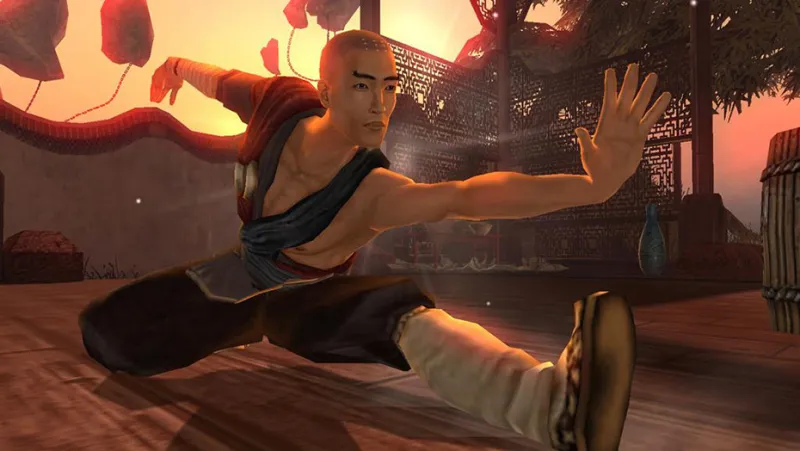
Jade Empire
As production ramped down on Jade Empire in 2005, Zeschuk and Muzyka started taking the many third-party funding offers being made to them seriously, primarily because they needed capital to pursue the production of an MMORPG, to open new studios, and to invest in new IP. One deal in particular from private equity firm Elevation Partners would pair BioWare with fellow developer Pandemic Studios (Star Wars Battlefront, Mercenaries).
Zeschuk: We had offers to buy us frequently. Ray had this file in his office where he kept all of them.
Muzyka: Every year or two there would be another kick of the tires. They never led anywhere.
Zeschuk: So we had low expectations for these guys. We’d take these meetings every once in a while, especially if the person was in the finance industry. We knew Greg Richardson from Elevation Partners. He was a good dude, and so he comes and says, “We’re interested.”
Muzyka: We were considering building capital at the time, because we wanted to build an MMO. We wanted to take what we thought was a logical extension of what we were doing with RPG games.
Zeschuk: We wanted to be with a legit group, too. Once you’re a partner it’s like getting married. And we clicked really well. At the end of the day, they still left us in charge of our business.
Muzyka: It was one of the best periods at BioWare I can recall. It was a really fun period where we transformed the business from a development studio to that plus more.
Zeschuk: We got to dream big. They really let us imagine what we could be. And as Ray said, what was really neat was that with Pandemic, we knew those guys a bit, got to know them pretty well. We don’t get a lot of chances to look inside other development studios and see how they’re run.
Two years later, full purchase offers started coming in from publishers. In 2007 Elevation Partners founding partner John Riccitiello, now CEO at Electronic Arts, made a $860 million push to acquire the RPG hit-maker.
Muzyka: We got an offer from EA that we couldn’t refuse, and it was good from every dimension. Not just financially, but creatively as well and in terms of the things we’d be allowed to do, providing liquidity to our employees.
Zeschuk: It’s interesting because with Elevation they said you have the ability to refuse it.
Muzyka: It was actually an open discussion.
Zeschuk: Yeah, it wasn’t like, “Yeah we got a good offer, you’re sold. Here’s the doc, sign it, see you later.” It was actually an interesting conversation about the pros and cons.
Muzyka: It was a lot of money. But we didn’t do it just for the money. Liquidity for our staff was a big part. The private equity guys were happy too, it was a nice multiplication of what they paid. But we also wanted to do what becoming a partner at EA would allow us to do. Become a publisher, have more flexibility and a global reach, and pursue new things and grow the business further. Offer more benefits to our staff, too. There were a lot of reasons to do it, and we thought seriously about it.
Flynn: When the announcement [of the acquisition] came down they called us down to a ballroom in the building/hotel we work in. Ray and Greg put a slide up and said we’ve sold the company again. When we realized what was going on we were like, “Oh my God.” There were gasps in the audience, people saying, “No, you’re kidding. What?”
Watamanuik: We were reasonably independent, and then we were being bought out by one of the largest video game companies in the world, so of course there was trepidation. There was bit of a wait-and-see attitude about what would happen.
Flynn: There was a lot of concern and skepticism. We knew that there had been a pattern at EA of acquiring studios with much fanfare and money and such, and then lo and behold not long after the studios didn’t survive. You were shut down or everyone had left and then shut down, whatever it was. There was a lot of nervousness and concern. I think it was only the huge amount of trust that we had in Ray and Greg that got us through that.
Darrah: EA did a very good job of telling us that they were going to largely leave us alone. When we were acquired…they had adopted a city-state model, which was essentially that they wanted studios to be relatively independent of each other.
Flynn: John Riccitiello flew up at the time of the acquisition and spoke very sincerely and honestly about why this was going to be different and why it made perfect sense to have BioWare and Pandemic join EA at the time. They were very conscious of their reputation, too, and they didn’t shy away from hitting it head-on and saying, “We know that, that’s on us, but what do we do? Never try to acquire anyone again, or do we try to do it again and do it right?”
Watamanuik: We’ve built those relationships slowly but surely over time, and now we have great working relationships with Frostbite and working with them and coordinating on technology with them. It’s an extremely rewarding relationship.
Zeschuk: You look back and see how much the games have actually made in the past, you know, six years or whatever it is – they made a lot of money. They probably made a return on their investment.
Muzyka: As soon as I became a SVP I got to see the original forecast, the projection, analysis they used to purchase us. I think we exceeded it in most respects.
Going Massive
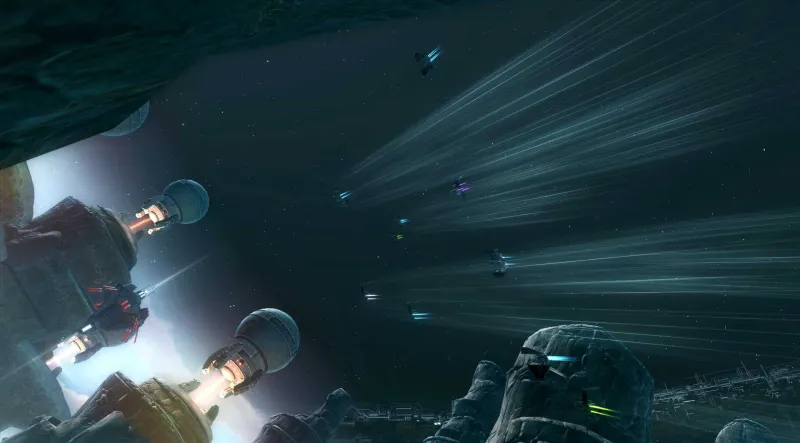
Star Wars: The Old Republic
With the cash influx from both Elevation Partners and then the EA acquisition, BioWare finally started pursuing its dream of releasing a grand-scale massively multiplayer online role-playing game in 2005. The long development required the opening of a new studio in Austin, Texas, and a lot of learning on the job.
Flynn: I used to play MMOs with Ray and Greg. I was playing Dark Age of Camelot, Asheron’s Call, and Star Wars Galaxies. We would ask, “Are we ever going to make an MMO? This seems like a really cool thing we could do.” They would say, “Well, we know Rob [Pardo] at Blizzard and it’s a huge investment. It takes an entire studio to do that, and you have to dedicate yourself to do that.” Then when World of Warcraft came out, everyone was like “Wow, okay, this is a game-changer. This is amazing.”
Ohlen: BioWare is a business as well, and Ray and Greg have always been cognizant of that. One of the things that we felt was that online was going to be a big part of the future of gaming, and we really needed to be a part of that if we were going to be a successful business.
Zeschuk: I think for us it was a natural evolution of what we were building. We had toyed with it with Neverwinter Nights. We felt it would be fun to apply the BioWare principles to an MMO. To change the paradigm of what the experience was and put our stamp on it in a sense.
Ohlen: I was doing pitches with my lead writer, who was Daniel Erickson at the at the time. We were pitching all sorts of potential online RPGs. One based in the Dragon Age world, one based on the Game of Thrones world, what would a Stephen King Dark Tower MMO look like? We actually were thinking about doing The Silmarillion MMO, because at the time Elevation was our private equity partner, and Bono was one of the partners. Ray and Greg convinced Bono to phone Christopher Tolkien to see if he would be willing to allow us to work on The Silmarillion as a game, and Tolkien wouldn’t even take Bono’s call [laughs]. He’s a grumpy guy.
Muzyka: We thought we’d make something that would reach a large audience, and Star Wars was one of the best IPs to do that.
Zeschuk: One of the benefits along the way of being part of EA is EA had bought Mythic, and Mythic was filled with people who had launched multiple MMOs. A lot of those people came and joined the team in the latter part and were able to help.
Ohlen: It was 2006 and Ray and Greg had called me into their office – I always get these surprises – they’re like, “Hey James, you know how we’ve been discussing about starting up a new studio?” I was like, “Yes.” They’re like, “Well we’re going to do it down in Austin. We have Richard Vogel and Gordon Walton that we’re going to do it with, but we want someone to represent BioWare, so how about you go down to Austin?”
Zeschuk: Making regular games is hard. Making MMO games is even harder. And then the apples and orange comparison of existing MMOs is even harder. When you think about it, MMOs to some degree are habit forming. It’s the habit of 10 p.m. or 8 p.m. you turn on your computer, you meet your friends online, and you do your stuff. People do this for years and it’s just this habit they are in. So to try and interject your experience into that is very hard.
Ohlen: We had to ramp up from 10 to eventually 400 employees, so that was just one of the challenges. Just creating a pipeline of getting new talent into the studio. We also had to create a huge pipeline for all the story content we were going to do.
Zeschuk: You’re always amazed how fast people play through the content, and our thought on the game was we wanted people to play multiple paths. We kind of knew the endgame was a little thin, but it’s funny what the expectation for the end game actually is. I think what happened is Blizzard had trained people into this extreme endgame treadmill, which is to say that’s what worked for them. We wanted to try and go a different way, but at the end of the day we kind of fell in line in a way.
Muzyka: We always tried to have a little bit more than what we thought would be required. Some of that is tempered by the reality that there’s more mature MMOs out there that have more endgame developed. It doesn’t really matter what they launched with, it’s what they have now that people compare you against. I think we knew we had to build more content and quickly.
Ohlen: I’m very proud of what we accomplished with Star Wars: The Old Republic. Sure, when it launched it didn’t become the success that we had wanted it to be. But it was the challenge of starting up a brand new studio, wrapping up all those people and delivering a game in a completely different genre, and we did it in five years when you look at it. I’ve been told “Five years is a long time, James.” I’m like, “Come on, five years to do all that stuff is actually pretty good.” We did spend a lot of money [laughs], and there was a lot of press on that obviously.
Zeschuk: Where did the $150 million number come from? I think it could be simple mathematics. There were a lot of people in the studio.
Muzyka: People probably took the rough guess of how many people were there and multiplied by time. I mean we never confirmed it. We never said what it was or wasn’t. We’ve never talked about that. That’s a proprietary piece of financial information for EA.
Zeschuk: World of Warcraft obviously continues to plug along, and now the Old Republic is still doing really, really well. I can’t say any numbers, but it’s like shockingly well, which is great. It’s just the expectations were for a WoW-level success. We actually were probably up to two million playing at one point, so it was huge.
Building A Space Trilogy
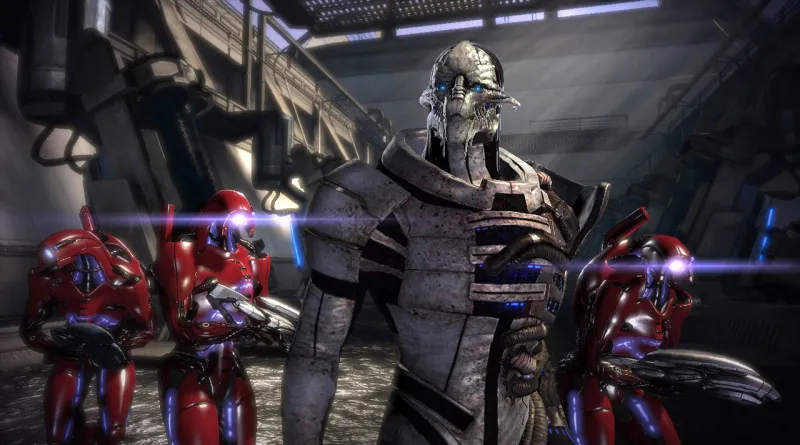
Mass Effect
After releasing Knights of the Old Republic and Jade Empire, BioWare continued toward its goal of building sustaining gaming brands that it owned in whole. For its next major project, the studio aimed for the stars.
Zeschuk: I remember we started with me, Ray, and Casey sitting down at this Greek restaurant down the road from BioWare, and Casey says, “I want to make a big giant space opera.”
Muzyka: We took some pens and paper out and started taking notes. We had a series of lunches as I recall at Yianni’s.
Zeschuk: That was the Mass Effect place as a result.
Flynn: Casey and the team really did foresee it as a trilogy and wanted people to understand that the stories are too big and the progression is too important to keep to one game and just kind of see what happens after that.
Hudson: We wanted to combine the things that we loved about science fiction and the potential of this kind of story, which is like, you’re still building a crew, you have a ship, and you have access to the whole galaxy and space exploration. But we really wanted to push on the space-exploration aspect, really let you go to uncharted worlds.
Watamanuik: Those meetings were extremely exciting. Building a new IP is simultaneously, in games, the most rewarding slash most terrifying thing you can do.
Flynn: Some of the ideas we had were “adulting” it up with romances and relationships. Taking it from PG to mature. And then giving ourselves [permission] to tackle the themes that come along with that.
It would be about building characters and animation systems so that these characters could really act, and that you could interact with them in ways that are very much about the emotion of the moment. And then, building that into not a “good” and “evil” system, but more of a sense of really challenging moral decisions. That was kind of the idea.
Zeschuk: We almost always build too much content to start, and then you cut out a few planets and you have to patch it together. Our eyes are always bigger than our stomachs. And that’s one benefit of the trilogy, you go, “Let’s just move this one over there, and move that whole arc on this planet or world into the next one and then we’ll tighten this one up a bit.”
Watamanuik: We knew the story of Shepard would be three games, we knew it would evolve around the escalation of the conflict with the Reapers, and we knew that the ultimate endgame for that would be the showdown that you see in Mass Effect 3.
Muzyka: We thought announcing it as a trilogy it would get some attention. I guess that’s why we did that. And also it was to plant this stake in the ground to say this was going on in the long term and if you invest in it, fans, then we’re going to be in it for the long haul.
Zeschuk: We had a really hilarious set of conversations about what Mass Effect was with Microsoft because they were just not getting it. I shouldn’t say they weren’t getting it. I should say they were concerned it was too much like Halo. So they kept trying to push it to these ridiculous non-confrontational story game things. They thought it was too close to Halo.
Muzyka: I don’t remember that.
Zeschuk: Don’t you remember Shepard as the diplomat of the universe?
Muzyka: Maybe I just ignored it because I didn’t think it was going anywhere.
Zeschuk: Well, no, we killed it. And that’s the challenge, actually, that you always have when you have your own thing. You can say, “Nope, Shepard’s a badass.”
Hudson: You have to push back on it in terms of what you believe in.
Zeschuk: There were a couple things along the way in Mass Effect we did, things like completely changing the combat system two months before we shipped and did a bunch of aggressive changes.
Muzyka: Interface changes as well because it wasn’t working two or three months before launch. I think it scared the s— out of our publishing partners at Microsoft.
Zeschuk: We would do that all the time. We would say we don’t like this, we’re changing it and they were like…
Muzyka: You know, we can actually thank them at the same time because their usability labs were awesome. We needed that feedback of players playing the game in the real world who weren’t familiar with it who were just like, “This isn’t fun,” or, “I just don’t get what I have to do next.”
Hudson: What I love both about KOTOR and what we do with Mass Effect is the stories that people relate to us about having played them. They’re such deeply emotional stories that people will talk about how they played it throughout their cancer treatment. Something for them to really focus on and be a hero who was pushing through adversity, that they could live through this character in an alternate universe and get to that kind of escapism.
Zeschuk: You could see it was resonating with the fans on the sci-fi side. It became a property that people really were attached to, which was wonderful.
Mass Effect proved a successful gamble for BioWare, earning widespread praise and entrenching the brand enough to solidify its prospects for the trilogy. For the second game, the studio focused on shoring up technical deficiencies.
Flynn: Ray and Greg had built into the studio a culture of critical feedback, not being afraid to evolve and change things. You see it very clearly over the course of Mass Effect 1, 2, and 3. They evolved tremendously. Definitely between ME 1 and 2. Even as it was a trilogy we were committed that we wouldn’t just end up with the same mechanics. If there was a better way to do something we would be fine with doing it that way.
Muzyka: The team knew what areas it wanted to target based on internal review, fan feedback, and critical feedback, as well as a lot more confidence about technology because we knew we would go back and do a reintegration of the final Unreal engine and that would be a good platform to build on. That led to a lot better framerate, and it was smoother and some of the little glitches that the first game had we were able to resolve.
Watamanuik: Between ME 1 and 2, I had a really great in-depth analysis done on the combat system by someone who was more of an action designer and a gameplay person. They gave a lot of really great insight into where we should be moving in order to turn the game into a better cover-based shooter.
Flynn: That era was the rise of the console shooter. Call of Duty 4 had just come out, and so we realized there was this amazingly clear set of mechanics. Gears of War did a great job with its third-person cover-shooter mechanic, so we just wanted to say that maybe the role-playing was better served in other places rather than the shooting mechanic itself and we’d stick with a more established shooting mechanic. That was the change in ME 2.
Watamanuik: That entire game was about the characters that you meet, how you felt they were kind of like real individuals, and then the fact that you had to risk them at the end to actually accomplish your mission, right? I think at the core that’s a pretty interesting premise.
Zeschuk: It became a property that people really were attached to, which was wonderful. We wanted to create a game that was appealing to everyone, not just a narrow group.
Mass Effect 2 earned universal praise, landing BioWare its highest Metacritic rating to date. Moving into the final chapter of the Mass Effect trilogy, the studio had a lot to live up to.
Flynn: Obviously the ambition of the team that made Mass Effect 3 was to fulfill the promise of the overall trilogy, especially after a 96 Metacritic and all that kind of stuff. They felt like ME3 would be a lot of hard work, but they knew what they had to do.
Muzyka: In terms of production values, quality of gameplay, the interactions, the animations, and the art, across the board I thought it was one of the best games in the franchise.
Flynn: I think we were very oblivious to criticisms of the ending as we were developing it. I remember about a week or so after we had launched it, we’d seen all these excellent critical reviews. EA was super proud of us and it was great, then all of the sudden people were saying, “I felt the ending was weak.” And someone would say, “Yeah, I thought it was actually pretty bad.” And someone else would say, “I hated that ending.” It just snowballed like crazy, and pretty soon the whole issue was on fire.
Watamanuik: I did an analysis of the ending just to say, “Well how many permutations do we have of the ending?” and before we released the extended cut we had like 42 million permutations of consequential things like this ship is there versus not there, this guy is dead, you have a conversation with this guy versus this guy. But people boiled that down to the last 30 seconds, right? And they, for better or for worse, focused on that as the entire trilogy.
Zeschuk: Because the whole game is based on making choices and controlling the character, and controlling the story, I think the moment the players feel like they have lost that they feel like the whole agency is lost, the whole premise is shot. It’s actually a fundamental thing, a lot more than the dialogue wasn’t right. “Hey, I don’t feel like it’s consistent with what I thought.” If anything, it comes back to everyone at the end of the day wants to pick their ending.
Flynn: We didn’t have a playbook for this. We were getting used to social media, we were coming to grips with almost a decade of development coming to a close ourselves, and lo and behold we have this incredible hot-button issue for the industry that was there.
Zeschuk: I think one of the other interesting things on that topic is there was an interesting level of solidarity from other industry people. You may recall, Ken Levine came out quite strongly supporting us. I remember that quite distinctly, and he gets it. He’s walked that walk.
Muzyka: Some of that support turned against us when we said we’re actually going to patch some changes. There was a lot of initial support saying this feedback is not reasonable, they shouldn’t have to change it. But when we actually said we are, then all of the sudden a lot of those creators flipped and said, “What the hell are they doing that for?”
Zeschuk: Exactly. It was a bit of a lightning rod.
Muzyka: We weren’t listening to that either, we were just kind of observing it and we respect all of those people. They have a right to their opinion just like the fans do, but we made our own decision based on what we thought was the right thing to do for the fans.
Flynn: I remember [former EA president] Frank Gibeau said to Casey and I, “Are you guys sure you want to do this? We’ll support you either way.”
Watamanuik: What we did is we clarified, and what we had said from the beginning is that we are not changing the endings. We are not adding a new ending, which we didn’t. But what we did do is add more clarity, because some of the feedback was, “I wish there had been more information about what happened.” And so we added that.
Getting Medieval Again
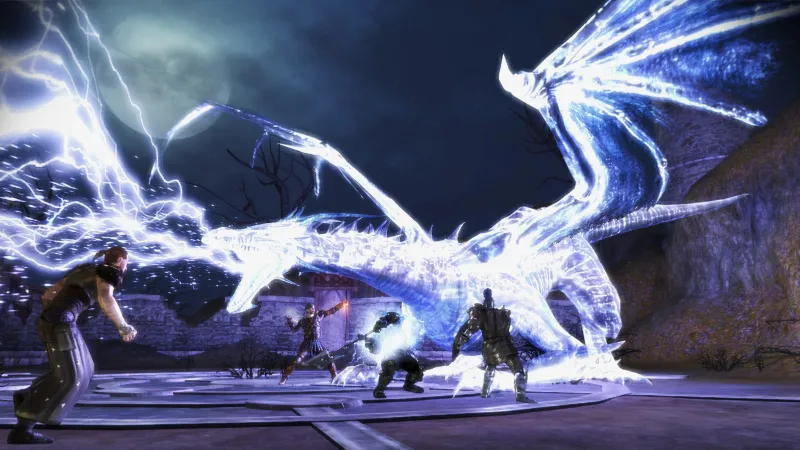
Dragon Age: Origins
BioWare stopped making Dungeons and Dragons games after Neverwinter Nights, but several of its developers still had a soft spot for fantasy role-playing games. For years, the team incubated ideas on how to make a spiritual successor to Baldur’s Gate.
Ohlen: We had given up on Baldur’s Gate and I felt that that was a mistake. I know it was a license, but I was like, “Alright, if we’re going to not do Baldur’s Gate then we have to do a spiritual successor because it’s a big part of who we are.” It was essentially, “How do we make our own Baldur’s Gate?” That was the genesis of it. I think from when we started working on the IP it was me and David Gaider who were working on the IP. I think that we were probably being really close to the standard norms of fantasy.
Darrah: Dragon Age Origins went through a lot of turns, because there was essentially a group working on it pretty much from the point that Neverwinter shipped. It was multiplayer at one point, then it wasn’t, then it was again, then it wasn’t. It was originally going to be PC only, and then the consoles got added.
Flynn: Ray and Greg had always had the perspective that you only get one chance to launch a new IP, so if we’re going to launch our own new fantasy universe, it has to be big and huge. I mean this was a time when The Lord of the Rings movies had already been out, and the bar had been set for what’s visually amazing.
Muzyka: It took a long time to get finished because the engine was being developed and the ambition to make it a lot of different things was maybe too broad.
Darrah: So the writers were really just pulling and pushing for getting the story together. There were a couple of factions within the design department. At the time Oblivion was recent, which had a very physics-driven world interaction, so one group was really pulling in that direction. even though we didn’t actually have a physics engine at the time. There were also some groups that were really just trying to double down on the toolsets and make it much more like Neverwinter.
Darrah: Everyone was kind of pulling in their own directions. They were mostly pulling in the same direction, but there was just a lot of disagreement. It had become much more about people implementing their own individual things.
Muzyka: When it focused down it became a really great game. It’s one of my favorites.
Darrah: I do think it did a very good job of establishing an IP. We probably oversold Grey Warden a little bit too much in the marketing material, but we did a very good job of establishing Dragon Age as this member of the pantheon of fantasy IPs.
Laidlaw: Seeing the initial responses come in, seeing people kind of look through it and say, “Well there’s some real benefits here, there’s some really cool world-building,” positive response to the origin stories and so on, was quite heartening.
For the second entry in the series, BioWare took on an aggressive development schedule unprecedented in its history.
Darrah: Dragon Age II was done in pretty much 14 months start to finish. We were working on what became Inquisition when we were asked to turn it around much more quickly, in part because of Star Wars: The Old Republic was kind of stumbling along. We wanted to tell a more personal story, and this seemed like a good opportunity to do it. So that’s why Dragon Age II is smaller and more focused on one character and the story of his family, as opposed to the story of saving the world. It’s a story I really like, but I think the story was also a big departure for BioWare.
Laidlaw: It was on a bit of a compressed timeline, so there were going to be some significant challenges to it. For me, a lot of the goals behind that were to try and figure out how we could develop the game that met that timeline goal, ideally while continuing to expand on the world and produce some more interesting content.
Darrah: I think the biggest sin we committed was reusing environments and pretending like they were different environments. You see a lot of games that actually have less, a lot less square footage than Dragon Age II does, but get away with it in large part because there’s no lie. But when we close the door and call this warehouse a different warehouse, or call this manor house a different manor house because there is some crates in front of the door, I think that criticism is very valid.
Laidlaw: The overwhelming commentary was that it was not a satisfying sequel to Dragon Age Origins, right? It failed to have the variety, it failed to deliver on as strong essential plot and premise. The combat had changed enough that it was perceived, and you know I wouldn’t argue with this, as charitably over-focused on action, uncharitably dumbed down. The experience as a result felt unsatisfying and like it wasn’t a Dragon Age II.
Muzyka: I think that’s some of the trouble we ran into for Dragon Age II. People had the expectation of something more nonlinear with exploration and a nonlinear story. Then we created barriers for them because the content, the art was a little more channeled. That and the less flexibility on costuming and character creation, all that.
Laidlaw: When I think back on it, if I had my druthers, you know, when we were building it, we were not entirely sure that it should be called Dragon Age II, so much as, at the time it had a working title of Dragon Age Exodus.
Zeschuk: We tried to streamline, and we went too far.
Muzyka: Exactly. We went too far.
Laidlaw: It went too fast, too actiony, certainly I’ve seen that feedback from fans extensively. Let no one think that they need to send me another tweet about Dragon Age II – I’ve read all the stuff there is to read, and even at great personal sanity expense.
Laidlaw: I came to BioWare because I wanted to craft good experiences. You’re not going to have a 100-percent success rate, but it doesn’t feel good when you feel like you’ve let people down.
Leveling Up And Away
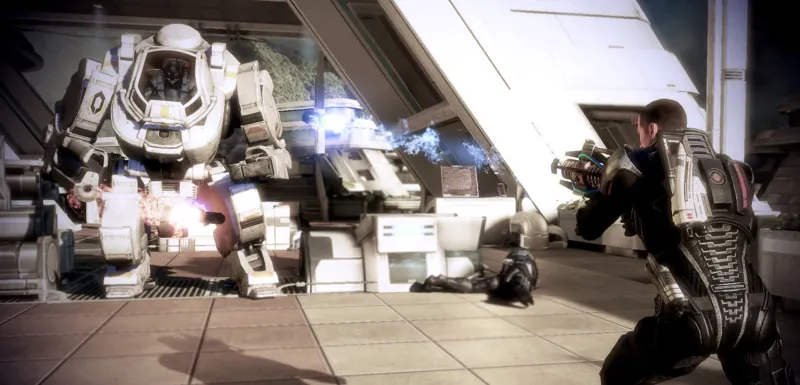
Mass Effect 3
Following the release of Mass Effect 3 in March, the Doctors made an announcement that shocked the video game industry just six months later – they were retiring and walking away from the RPG hit-making machine they built from the ground up.
Muzyka: [The development of Mass Effect 3] was bit melancholic for Greg and me because I think we were starting to mull over how much longer do we want to do this? Not even consciously at that point yet. It became conscious later in the year or early next year.
Zeschuk: People always ask was [the Mass Effect 3 controversy] the thing that pushed you over the edge? No, that wasn’t a part of the decision at all. We spent 20 years super-focused on something. When you have done what you set out to accomplish, I think that it’s time to move on.
Ohlen: They had been hinting at it for quite a long time.
Darrah: I kind of always figured they would kind of go together. Just because of the way their relationship had worked for so long. I think they probably felt they always had to do it together, end it off in one big swipe.
Urquhart: I think being at EA is different from running an independent studio. They had a lot to think about, and that led them to decide to try some new things.
Muzyka: I think we were tired just generally. Not tired of that situation, just tired and ready to try something different. That’s why I’m now doing angel impact investing in social enterprise, information technology, and medical innovations now at ThresholdImpact. It’s fun to try new things and apply what I’ve done before as a doctor and in BioWare to these new areas. I wanted to try something fresh.
Zeschuk: I’m just trying to make the BioWare of beer.
Ohlen: It was a tough time for the BioWare studio and a lot of people inside BioWare. For me, growing up with those guys, I look at them as having made me as not only the game designer I am, but the man I am overall.
Watamanuik: It was a sad day. You’re not going to lie about that, right? Those are the guys that most of the people in the room got their jobs directly from, Ray or Greg. And then those guys are leaving. That was the end of an era.
Muzyka: I really felt our team was really ready to step up and take the reins of the company. When you feel that it’s nice just to give them the space to do it so you’re not just still there and say we’re retiring and it’s in your hands now. You’re our chosen successors, and we’re here to transition for six months, and support you and help you, and good luck!
Ohlen: Before they left they made sure BioWare would be set up for success afterwards. Aaryn Flynn, who’s the GM of BioWare studios now, I see a lot of the best qualities of Ray and Greg in Aaryn. He’s kind of like Ray and Greg 2.0 [laughs].
Watamanuik: He was in the trenches for a long time. It’s not like we just sort of plucked a manager out of thin air from nowhere. Aaryn knows what it’s like to build a game.
Laidlaw: [The doctors] still come to the Christmas parties. So, they’re neither gone, nor forgotten.
The “Prove It” Game
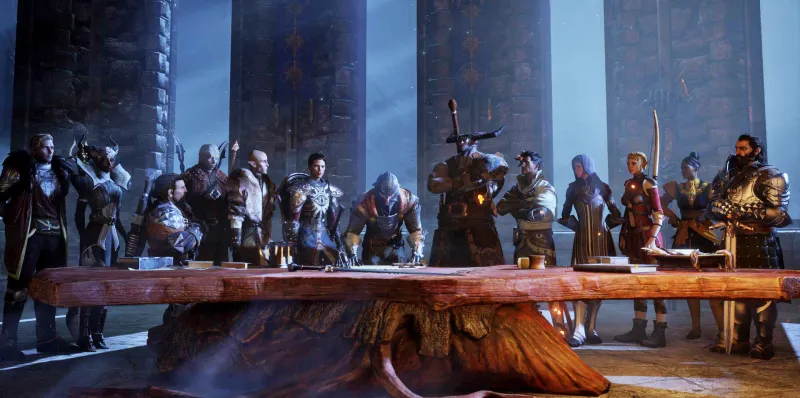
Dragon Age: Inquisition
As the first major game being created in the absence of the studio founders, Dragon Age: Inquisition had a lot more riding on it than merely recalibrating the Dragon Age series. The game also served as an opportunity for BioWare to prove it was still the high-caliber RPG studio without the doctors leading the way.
Darrah: A lot of the early days for Dragon Age: Inquisition were soul-searching in terms of the lessons of Dragon Age II and trying to respond to those criticisms…Dragon Age II definitely had lasting psychic scars on the Dragon Age team.
Laidlaw: We wanted to make sure that Inquisition was an excellent experience, and we knew we were going to be going uphill, right? An engine change is an immensely challenging, difficult time for any project. Moving to Frostbite was not going to be simple, and we knew we were going to have to deploy the game to five platforms.
Darrah: Because Ray and Greg were gone, but also because we were coming off of Dragon Age II, it was very important to show that this was still a strong franchise. Dragon Age: Inquisition absolutely had a lot riding on it in terms of being good.
Flynn: We felt an enormous amount of pressure. We knew with Ray and Greg having retired it was our chance to show that Ray and Greg had taught us well and we weren’t going to follow the apocryphal stories of EA crushing every other studio it buys under its thumb. We were determined to not let that happen.
Darrah: You look at the start with Baldur’s Gate I and then kind of follow the trajectory, our games were getting smaller and smaller and tighter and tighter. I’m glad we got back to exploration with Inquisition; even though it’s not a perfectly implemented feature there are a lot of lessons to be learned from games that have come since Inquisition. I think it’s just good that we’ve reasserted that our games include an aspect of world exploration, as opposed to we’re just making a budget version of Uncharted.
Laidlaw: We had to wander through the desert for a while to build up some of that expertise in the studio. But at no point did we ever really want to just make a Skyrim, where it’s all open world on its own. There was a heavy focus on having rich story elements, so that people didn’t feel like again it was letting down that legacy of Origins.
Muzyka: Dragon Age: Inquisition was the first BioWare game I played that I hadn’t played before it was launched. I think it’s the best thing they’ve ever done.
Flynn: It was actually our most successful launch of a game at BioWare.
To The Future
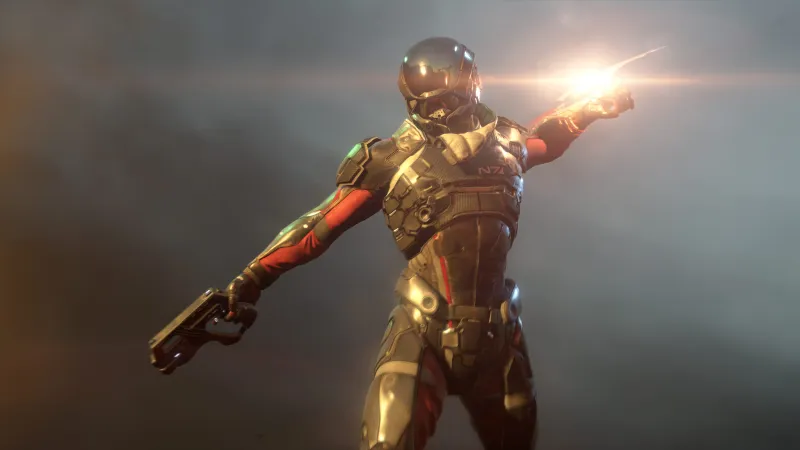
Mass Effect Andromeda
Dragon Age: Inquisition reviewed strongly and won several game-of-the-year awards from press outlets, including Game Informer. Now BioWare looks to the future with Mass Effect Andromeda, the next entry in the Dragon Age series, the continuation of Star Wars: The Old Republic, and a new game franchise being developed at the Edmonton headquarters.
Muzyka: One of the most exciting things for me is knowing that the team is going to do even bigger and better things and we can sit back as fans and just enjoy it now. That makes me very happy. I feel very lucky that we got to work with all the people we worked with over the last 20 years at BioWare.
Zeschuk: We get that weird question like, “Aren’t you jealous or mad?” It’s like, “No.”
Muzyka: No. I’m ecstatic. You’re like a parent. Your kid goes off to school. That’s how I feel about the company. I don’t have kids, my wife and I have cats. BioWare is sort of my kid, almost.
Watamanuik: I actually honest-to-god believe what people take away from our games is not the story, it is those characters they really loved and resonated with. At the trilogy, Garrus was not designed to be your best friend, was not designed to be that ultimate pal. We added that value because fans just cared; something about Garrus just resonated with people. I think it’s going to be the characters. I think it’s going to be the Wrexes, the Talis, those are going to be the kind of things that people remember. They might not remember even specifically the plot of any of the games, but they’re going to remember the characters that became their virtual friends.
Darrah: I feel like within the next year or so that the company will be able to accelerate ourselves. Not that we’re going to be shipping games everyday, but we should be able to deliver a better, more polished experience because we will able to focus more on that aspect of game development and less around just building the building blocks we’re going to use to put the games together.
Flynn: What I hope we accomplish at BioWare is to continue to be excited in doing things with new technologies, and telling better and better stories thanks to those technologies.


Leave a Reply